If you've landed on this blog by mistake, please follow this link:
www.Kentucky.PreppersNetwork.com Please update your bookmarks and the links on your sites. The KY forum is still the same URL: www.KentuckyPreppersNetworkForum.com
Join our forum at:
Showing posts with label Food Storage Tip. Show all posts

January 13, 2010

Food Storage Tip - Plan Your Meals


Wanting to have a 1 year supply of food on hand is one thing, getting the supply together is another. It might seem like a tough task to accomplish but it's a lot simpler than you think. To achieve a 1 year supply of food that you can rotate and eat on a regular basis is probably going to require you to change some of your eating habits. But that doesn't mean you're going to have to eat beans and rice for every meal. Most meals you already eat can be made with ingredients that will store long-term.

The first step to creating your working food storage is to develop a meal plan. This shouldn't be too hard because most families eat the same meals over and over. You need to sit down with your family and create a list of meals that everyone likes to eat. The more meals you're able to write down, the better, because variety is the key to any food storage.  (There are also a number of books out there that have recipes for food storage items.  These might help when planning meals.)  This should include meals for breakfast, lunch, and dinner. Once you have a good list of meals now it's time to start figuring out what ingredients will go into these meals that will store long term.

Most meals can be created with ingredients you can store long term. One good thing is to find commonalities between your meals; ingredients that would go with a number of your planned meals so you can store a lot of that ingredient. You can find a lot of your long term storage items at any supermarket, but some items you will need to improvise on, or purchase from a supplier. Your food storage needs to be independent of everything other than water and a heating source to cook with. Recipes that need things like cheese or milk that require refrigeration can be replaced with powdered cheese and powdered milk.

Some things such as meats can be home canned for long term storage, rather than relying on freezing them, which keeps you attached to the grid. Creating a long term food storage isn't hard, but will take some planning and work on your part. The use of a dehydrator can help you when creating your food storage. There are a lot of things you can do on your own (dehydrating and canning) rather than buying it all from suppliers which is going to be expensive. The idea is to create the storage, and not be out anymore money that you usually would when buying food.

SubscribeShare/Save/Bookmark

January 12, 2010

Are You Watching the Sale Ads?


You should be. I was browsing through the local Kroger ad and right off the bat saw a ton of great deals for preppers looking for build their food storage. Kroger runs a lot of 10 for $10 deals on a number of items. From salad dressing to deodorant you can increase your stock of just about everything by taking advantage of these sales. This is exactly how a prepper saves money and builds their food storage at the same time.

For example, this week Kroger has Kroger Brand canned fruit 10 for $10. That's only $1 a can. Canned fruit will store for at least a year and probably longer. Why not take advantage of this sale and stock up on canned fruit? True, it's going to cost you more money right now, but in the long run you won't have to go out and purchase the same fruit at the full price, you can just grab it from the pantry knowing you got it on sale. This translates into saving money on purchasing the goods you eat on a regular basis, along with building your pantry and food storage.

The same principle goes for anything you catch in the sale ads or have coupons for. Buy in bulk on sale, then when items are back at regular price you won't need to purchase them. As your stock of fruit (or any other item) gets low, next time you see it on sale go ahead and re-stock. This way you avoid ever having to pay full price for a lot of stuff you use, and you build your stock each time. This is the basic principle you need to follow when working on your food storage. There are many variables when considering starting a food storage, but this is something that is universal and that everyone can take advantage of.

SubscribeShare/Save/Bookmark

January 7, 2010

Food Storage Tip - Drink Mixes


Water is the most important part of your preparedness plan. Without clean drinking water you wouldn't survive more than 3 days. I have a lot of water stored as it is an important part of my preparedness plan. As much as I like water I would hate to be stuck drinking only water for an extended period of time. There are many ways to break the monotony of drinking water all the time. These include flavored drink mixes, tea, coffee, and protein drinks.

Having some of these included in your food storage will help break the cycle and give you some variety in what you drink. Variety should already be included in your food storage, but it's just as important to have variety with your water storage. Most stores and supermarkets have large jars of flavored drink mixes that are very inexpensive. You can get Kool-Aid mixes, Gatorade mixes, Tang, and a number of other mixes.

These come in all different flavors so everyone should be able to find something that they like. Tea bags are also a good thing to store as they last a long time, and most people like a nice cup of tea. And for all the coffee drinkers out there make sure you have some coffee stored for those early morning pick-me-ups. Another option is to store protein powder drinks. These come in a lot of different flavors and types, and most are high in calories and vitamins, which would make it perfect for a quick meal on the go.

No matter which one you choose, having something to add to your water, giving you some variety is going to be beneficial. If nothing else having something flavored to drink, and possibly sweetened with sugar from your food storage is going to boost your moral in the event of a disaster. I like water just as much as anyone else but nobody wants to drink only water everyday. If you have children this is something that's very important.

SubscribeShare/Save/Bookmark

December 22, 2009

Food Storage Tip - Using Mylar Bags

If you're working on building up a food storage one of the things you need to be thinking about is how to make the foods your storing last the longest while sitting in the pantry. Rice, beans, sugar, pasta, and anything else you store is going to last only so long in it's original packaging. You need to have a way to store these foods so that they will last longer and there are a couple different ways to do this.

One way is to vacuum seal them. I've talked about the importance of a vacuum sealer in a previous post, so here I'd like to discuss a different method. Using mylar bags to store food in might be one of the most popular ways to increase the shelf life of items in your food storage. You can store just about anything in mylar bags from rice to sugar to your dehydrated vegetables. Mylar is widely used in the food storage crowd because it reduces the light that can enter, doesn't absorb moisture or oxygen, and doesn't absorb smells.

Mylar bags can be purchased in a variety of sizes, from bags that will line a 5 gallon bucket to smaller bags that would fit in a #10 can. Mylar bags are usually used in conjunction with oxygen absorbers. You fill the bag with your food storage item (rice, beans, sugar, wheat) add in the right size oxygen absorber for the bag size that you have, and then seal the bag. Overnight the oxygen absorbers will create a vacuum inside the bag that will prohibit bacteria and parasites from growing and ruining the food.

Here is a chart that's posted on USAEmergencySupply.com that shows how many oxygen absorbers and what size to use with what size mylar bag you are using and also based on what you're storing.
Container Type Wheat/Flour/Grains/Rice
(More Dense/Less Air)
Pasta/Beans
(Less Dense/More Air)
Mylar Food Storage Bag 20in. x 30in. (5 and 6 gallon) 100cc: 10-20
500cc: 2-4
100cc: 20-40
500cc: 4-8
Mylar Food Storage Bag with Ziplock 18in. x 28in. (5 and 6 gallon) 100cc: 10-20
500cc: 2-4
100cc: 20-40
500cc: 4-8
Mylar Food Storage Bag 12.5in. x 18in. (1.5 gallon) 100cc: 5
500cc: 1
100cc: 5-10
500cc: 1-2
Mylar Food Storage Bag 10in. x 14in. (1 gallon) 100cc: 4
500cc: 1
100cc: 4
500cc: 1
Mylar Food Storage Bag with Ziplock 8in. x 12in. (1/2 gallon) 100cc: 2-4
500cc: 1
100cc: 2-4
500cc: 1
Mylar Food Storage Bag with Ziplock 11in. x 16.2in x 5.75in. (1.25 gallon) 100cc: 5
500cc: 1
100cc: 5
500cc: 1

Note, these are average amounts. You may need more or less depending on your individual conditions and the remaining residual volume of air. There is no danger in adding too many.

Oxygen represents 20% of the total volume of air and the number in cc's above represents the amount of oxygen that would be absorbed.

Conversions: 1cc = 1ml. 1000ml = 1 Liter. 3.78 Liters = 1 gallon.

Sealing the mylar bags after you've put in your food and oxygen absorbers requires heat. You can purchase expensive mylar bag sealers or you can improvise and seal the bag with what you might already have around the house. You can use a regular hair straightener to seal the mylar bags, and you can also use your standard iron. Using the hair straightener to seal the bags is pretty straightforward, just clamp it down to create the seal. When using an iron you will need a surface and an aluminum level works great, just as the man shows in the video below.


SubscribeShare/Save/Bookmark

November 16, 2009

Invest in your Future


Most people who are looking to get prepared don't have a lot of extra money. They're not going to be the kinds of people to invest in the stock market or other investment strategies because let's face it, it takes money to invest. In times where markets are so volatile, gold is up, and the dollar is down, there is something that you can invest in. Things aren't getting any better with the economy and investing in your future or something we can all do.

I'm talking about investing in your preps. Even if the economy doesn't totally collapse, all of the money that's being pumped into it is going to cause at least some inflation. Inflation is going to cause some things to go up in price more than others and food is something that is already going up in price; albeit fairly slowly but in the future the price could rise more rapidly. This is why investing in your food storage and other preps is very important, and a great way to invest your money.

Food is an asset, something that we all need and by buying it now, while it's cheap, you're going to benefit greatly by not having to pay higher prices in the future. It basically equals a return on your investment in the form of not having to purchase it at a higher price in the future. This is a great way to invest some of your money and in these economic times it's a lot smarter than investing in stocks or other outlets when things are so uncertain. What is certain is that you're going to have to eat, and by getting your storage together while it's cheap you're going to save a lot of money in the long run and free up tight funds in the future for other things.

SubscribeShare/Save/Bookmark

October 11, 2009

Food Storage Tip - Label with Purchase Date

The idea of having a rotating food storage is nothing new. Simply put, it means you have a number of the same food item. The oldest item is eaten first while the newer one is shelved for later consumption. This goes for most of your food items that last a while especially canned goods. The key to keeping track of your food storage it to label each item with the month and year you purchased it.

With items that are labeled you can easily tell which items are oldest and newest. You don't have to play a guessing game to find out which can of food to open first. When organized in your pantry, shelf, or closet, the oldest would be at the front of the shelf for easy access, with the newest at the back. In case you get disorganized or someone comes along and messes it up, you still have the dates on the cans so it can be re-arranged.

I'm not talking about anything fancy, although you could use a nice label maker to label them. Personally, I just use a permanent marker and write the month and year on a spot that is easily readable. Canned goods are easy because they have a silver top and a black permanent marker is visible and works great on them. It would also be best to write the date on the can itself rather than the label in case the label was ever torn off.

SubscribeShare/Save/Bookmark

September 29, 2009

Food Storage Ideas - Breakfast

Keep in mind when planning your food storage that breakfast is the most important meal of the day. To ensure you are awake, alert, and have plenty of energy it is important to eat a good breakfast every day. There are plenty of options of what to store in your food storage for breakfast. The problem with some options is a lot of them take a lot of time/energy to prepare; not to mention the cost. Here is an idea as an alternative to your regular breakfast and something you can rotate with your storage.

Quick Oats. Quick oats possess all the qualities of a great survival food. They're quick, easy, nutritious, filling, and cheap. Quick oats are purchasable at any major supermarket or grocery store and have a shelf life of at least 1 year. One can purchase a 2+ pound container of oats for around $3. The 2lb. container of oats has 30, 1/2 cup servings per container. 1 container is enough for 1 person for a whole month! 1/2 cup of oats is enough to fill up nearly anyone for hours. They are cholesterol free, sodium free, and have a good amount of protein, fiber, and potassium.

Now trust me, eating plain oats everyday for a month would be torture. But the good part is you can add nearly any combination of additives to the oats to increase taste, flavor and variety. Honey is the first additive, and something that should be added to each serving. Honey is a natural sweetener and is jam packed with nutrients that your body needs. A 6 pound bottle of natural honey at your local warehouse retail chain will run you around $10 and has 108 servings in 1 bottle. Honey will make the oats sweet and a lot more tastey and edible.

There are endless combination's of things you can add to your oats. Honey should be added to all servings of oats. I also add 1 tbsp of cinnamon powder for additional flavor. Breakfast is also a great time to get in some fruits and adding your dehydrated fruits to the oats will give you the variety you need to eat it nearly every morning. I've eaten oats with dried blueberries, dried apples, raisins, and dried banana chips. Quick oats and the for-mentioned dried fruits are all included in my 3 month supply and the money that you save on breakfast frees up funds to contribute to the other meals or other preparedness supplies.

SubscribeShare/Save/Bookmark

September 10, 2009

Cooking with Ramen Noodles

Ramen noodles is one of the best and most versatile survival foods you can have. Mainly because they are cheap, quick, and easy to prepare. There are lots of different types of Ramen; from chicken, to shrimp, and beef flavored. I personally like Ramen noodles and eat them often. They don't have a lot of nutritional value but will fill your belly and keep you going.

The great thing about Ramen is the fact that it is so versatile. You can mix just about anything in with Ramen noodles and create a delicious dish. In my food storage I keep Ramen noodles as the base for any noodle dish. Ramen can also be added to other dishes that require noodles. They cook very fast (around 3 min) which is usually a lot faster than other noodles on the market. If you just use the noodles and not the spice packets, you can save those for a later dish. No need to waste.

Ramen noodles are great with spaghetti sauce. I keep Ramen and spaghetti sauce in my food storage for making a quick spaghetti dish. You can also add Ramen to chili, I like noodles with my chili and Ramen goes great with it. You can also add any "cream of" soups to Ramen with some spices and have a nice filling soup. There are endless combinations of cooking with Ramen. It's a great addition to your food storage, and will take the place of most other noodles in any dish. Toni Patrick has a book called 101 Things to do with Ramen Noodles. I've read this is a good book with lots of good recipes.

SubscribeShare/Save/Bookmark

September 8, 2009

Food Storage Tip - Spices

It is important to ensure that your food storage has enough variety so that you won't get tired of eating the same thing. If you eat the same thing over and over it can hurt your appetite and put you in a very dangerous situation where you wouldn't even be hungry. One way to help avoid that is to keep a variety of spices in your food storage. Spices are a great way to add variety in your foods while still eating some of the same ingredients.

Spices are really cheap. At most supermarkets you can get a bottle of spices for around $1. Spices are a great way to add additional variety in your food storage. For example, you can use italian seasoning for spaghetti, or put some red pepper in your canned soup for an extra kick. Spices are cheap so there's no excuse to not make them an important part of your food storage.

I would suggest getting all of the "basic" spices. Italian seasoning, lemon pepper, red pepper, seasoning salt, onion powder, garlic powder...ect. Stocked with just the basics you would be able to liven up any dish you prepare from your food storage. The purpose of storing food is so you can still eat good in the event of a disaster. With the proper spices on hand you can guarantee that your meals would be tastey and ensure that the family would want to eat the food.

SubscribeShare/Save/Bookmark

August 5, 2009

Starting your Food Storage

Your food storage is the most important part of your preps. Not only that, but a rotating food storage. You must store what you eat, and eat what you store. This might seem like a daunting task but it is very simple and I'm here to show you how. Before you purchase your first can of beans you must have some idea of what you want to store and eat.

Most families or individuals eat the same meals over and over. Setting up a meal plan shouldn't be a problem for most people. Sit down with your family and map out a meal plan. If you like a lot of diversity you can plan as many meals as you like. It would be best to try to use some of the same ingredients in each meal. Spices can dramatically change the taste of a meal without changing many of the ingredients, so use them as much as you can. I suggest getting some sort of beans or rice in every evening meal. Beans and rice are good for you, and are great fillers.

I would suggest no less than 14 different meals for breakfast, lunch and dinner. Once you have your meals planned then you can start buying the ingredients. Buy a little bit at a time, and buy canned or other foods that will store for a while. Each time you buy a can of beans or a bag of rice; buy two. This way you can start eating on the one, and store the other one. As your food storage gets bigger and bigger you will eat the items that you purchased the earliest. Once you get the hang of this it will become second nature. You can set your own personal goal but I challenge you to work towards a whole year of food storage.

You can have you own grocery store in your pantry or basement. No need to run to the store, it's all in your own home. This also might seem like a big task but working on it a little at a time you will be there in no time. And by buying a little bit at a time it's not going to cost you a lot. If you have a garden you can can or dehydrate your own produce or do the same with purchased produce. There are tons of different ways to do this but as long as you have a meal plan mapped out and the ingredients available for those meals you're going to be in pretty good shape.

SubscribeShare/Save/Bookmark

July 9, 2009

A Guide to Pressure Canning

I have never done any pressure canning myself, but if you have a garden it's a great way to preserve and store your own homegrown food for later use. Pressure canning is fairly simple and can be used to can just about anything. With a little studying and practice you can be canning the food from your garden in no time. Below is a guide to pressure canning written by the Utah State University Extension. A PDF version of the guide can be viewed here.


Why Choose Pressure Canning to Preserve Food?


Pressure canning is a safe and economical method of preserving low acid foods which has been used for decades, especially by home gardeners and others interested in providing food storage for their families where quality control of the food is in one's own hands. Home food preservation also promotes a sense of personal satisfaction and accomplishment. Further, the guess-work is taken out of being able to provide a safe food supply at home when guidelines for operating a pressure canner are followed exactly, scientifically tested/approved recipes are utilized, and high quality equipment, supplies and produce are used.


What Foods Are Typically Processed/Preserved Using a Pressure Canner and Why?

Low acid foods require a higher temperature when processing than can be reached by placing them in jars immersed by boiling water. To kill harmful bacteria (such as those associated with botulism) use of pressure canning ensures the safety of the preserved produce. Foods such as red meats, sea food, poultry, milk, and all fresh vegetables, with the exception of most tomatoes, fit into the low acid group since they have an acidity, or pH level, of 4.6 or higher. The temperature which must be reached and maintained (for a specified amount of time) to kill the bacteria is 240 F. This temperature can be reached only by creating steam under pressure.


Becoming Familiar with the Parts of a Pressure Canner

Photobucket

Older model pressure canners (made before 1970) were heavy-walled kettles with clamp-on or turn-on lids fitted with a dial-type gauges. A vent port, in the form of a petcock or counterweight, and a safety fuse were also present. Modern pressure canners are lightweight, thin-walled kettles and most have turn-on lids. They usually have a perforated metal rack or basket with handles, rubber gasket, a dial or weighted gauge, an automatic vent/cover lock, a vent port (steam vent) to be closed with a counterweight or weighted gauge, and a safety fuse.

Note: When purchasing a used pressure canner, make certain all parts are accounted for and in good condition. It is nearly impossible to find replacement parts for older models.


Selecting The Correct Processing Time and Pressure

To ensure the safety of food processed in the pressure canner, use processing times listed for scientifically-tested recipes (dated 1988 or later) and adjust for altitude using the chart below. Keep in mind that failing to follow proper processing times and pressure recommendations may result in spoiled food (mold, bacteria, and other microorganisms) and possibly fatal food poisoning.


Steam-Pressure Canner Altitude Chart

The steam-pressure method is used for low-acid foods. Normally, the pressure given for low acid foods in canning guides is for weighted-gauge canners at altitudes at or below 1,000 feet above sea level. At altitudes of 1,001 feet of above, adjust the processing pressure according to the Steam-Pressure Canner chart for the type of steam-pressure canner being used.


Altitude (feet) Weighted Gauge Dial Gauge
0 - 1,000 10 11
1,001 - 2,000 15 11
2,001 - 4,000 15 12
4,001 - 6,000 15 13
6,001 - 8,000 15 14
8,001 - 10,000 15 15


Steps for Successful Steam-Pressure Canning

1. Put 2-3 inches of hot water in canner. Place filled jars on the rack, using a jar lifter. Fasten canner lid securely.

2. Leave weight off vent port or open petcock. Heat at the highest setting until steam flows from the petcock or vent port.

3. Maintain high heat setting, exhaust steam 10 minutes, and then place weight on vent port or close petcock. The canner will pressurize during the next 3 to 5 minutes.

4. Start timing the process when the pressure reading on the dial gauge indicates that the recommended pressure has been reached, or when the weighted gauge begins to jiggle/ rock.

5. Regulate heat under the canner to maintain a steady pressure at or slightly above the correct gauge pressure. If the pressure reading goes below the recommended pressure, you must bring the pressure back up and start the timing process over again from the beginning.

6. When timed processing is completed, turn off the heat, remove canner from heat (if electric range), and let the canner "depressurize" at room temperature. (dial needle moves back to "0" or no steam sounds when weight is gently nudged). Do not force-cool the canner. Releasing pressure from a partially opened vent or placing the canner under cool water will result in under-processing. It may also cause unsealed jars and loss of liquid from the jars. Quick-cooling can also warp the canner lid of older model canners.

7. After the canner is depressurized, remove the weight from the vent port or open the petcock. Wait 2 minutes, unfasten the lid, and remove it carefully. Lift the lid away from you so that the steam does not burn your face.

8. Remove jars with a lifter, and place on towel or cooling rack, if desired. Do not set on a cold surface or expose to breezy conditions.


Additional Safety/Operating Tips

Gauges: Check dial gauges for accuracy before use each year and replace if they read high by more than 1-2 pound pressure. Gauges may be checked at most county Cooperative Extension offices. Replacement gauges and other parts for canners are often available at stores offering canning equipment or from canner manufacturers. When ordering parts, it will be helpful to know the model number of your canner.

Gaskets: Handle canner lid gaskets carefully and clean them according to the manufacturer's directions. Nicked or dried gaskets will allow steam leaks during pressurization of canners and should be replaced. Keep gaskets clean between uses. A lid which is difficult to remove after cooling may indicate a gummy, or dry gasket and is reason to replace it.

SubscribeShare/Save/Bookmark

June 12, 2009

Canning (bottling) Chicken

Here's a great post by Phil08 from Utah Preppers Network. Phil shows us how he and his family stock up on chicken that they get on sale. This is a perfect example of storing what you eat, and eating what you store. Buy the chicken on sale, with coupons if you have them, and buy a lot of it. Spend a little extra time to can the chicken for long term storage, and then you never have to pay full price for chicken! This principle goes with any other food also. Now onto the post...

One important and often difficult to achieve aspect of a good food storage plan is meat. My strategy had always been to purchase canned meat at the grocery store or through group buys, but that gets pretty expensive! We recently learned about and tried bottling chicken. I had heard about it but it sounded like it was probably a huge job. Then Mom told me a couple weeks ago that it was really easy – she was right (of course)!

Here’s the simple description for bottling chicken: cut it up into 1 inch square chunks, put 1/2 tsp salt in bottom of bottles, put chicken in bottles, pressure cook it for 90 minutes. That’s it, super easy!

But, that’s too short of a blog post so here is the photo essay of how to can or bottle chicken. Incidentally, I’ve been told that you follow the same procedure to bottle beef, venison, elk, any meat.

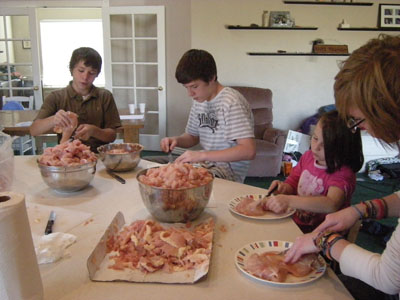
To start with, we bought 80 pounds of raw skinless boneless chicken breasts from a great sale at Macey’s – at $1.19/pound. Fortunately for me, I have lots of kids who can help out, makes a big job happen quickly.

Here we are cleaning fat off the chicken and cutting up the breasts:
cutting chicken Canning (bottling) Chicken


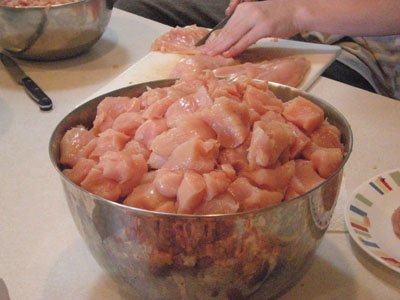
The meat needs to be cut into about 1 inch square chunks:
cut chicken Canning (bottling) Chicken


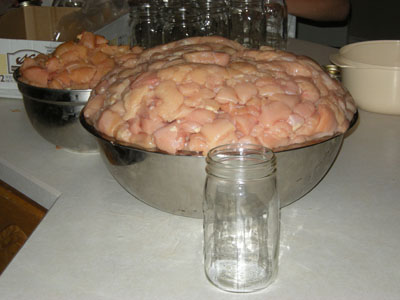
Here is what 80 pounds of chicken looks like all ready to be bottled (notice the quart jar for perspective):
all chicken cut Canning (bottling) Chicken


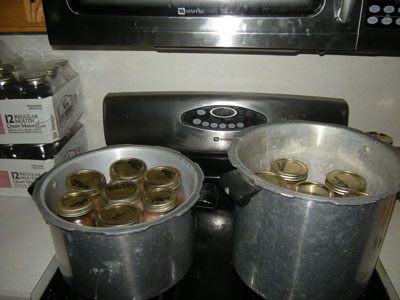
The next step is to put 1/2 teaspoon of salt in the bottom of the jar (you can add whatever seasoning you like) then fill the jar with chicken to about 1 inch below the top and load them into the pressure cooker:
loading cooker Canning (bottling) Chicken


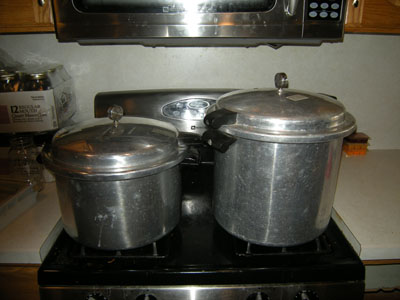
Heat up the cookers on high until they start rocking, then back off the heat until you get 3 rocks a minute, in the mountain region cook at 15 pounds of pressure. Maintain 3 rocks/minute for 90 minutes (time starts after first rock).
cookers going Canning (bottling) Chicken


After 90 minutes of cooking, turn off the heat and let the cookers sit for 30 minutes – DO NOT open them before hand, they’ll blow up! After 30 minutes, remove the rocker, if it hisses you still have pressure – WAIT until it doesn’t hiss!

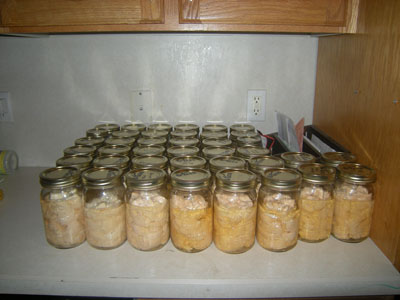
We averaged 2 pounds of chicken per bottle giving us 40 bottles:
bottled chicken Canning (bottling) Chicken


Notice in the picture that there is liquid in the jars – that’s broth baby! You don’t put any water in them at all, the cooking process fills the bottle up with juice.

After all our hard work we feasted on a bottle – it was delicious! The fully cooked chicken comes out of the bottles and falls apart and tastes wonderful.
So, let’s calculate. For about $2.50 on sale, you can buy a small tuna size can of chicken that weighs 10 ounces. We’ve got about 32 ounces in each jar, giving us a little more than 3 cans in each jar. That puts an equivalent value of $7.50 on each jar and we got 40 jars worth. That gives us $300.00 equivalent value of chicken – and it costs us $110.00 – $80 for the chicken and $30 for the jars. So we saved about $190.00 and ended up with a lot of chicken for storage! Next up for us is to do this with hamburger. I have about 80 boxes of hamburger helper in storage – my goal is to have a bottle of already cooked hamburger to go with each box.

- Phil801

SubscribeShare/Save/Bookmark

April 13, 2009

Save Money and Build Your Food Storage With Coupons

Part of the prepper mindset is cutting back on expenses and saving money. Most realize you can turn lights off when you leave a room or take shorter showers and conserve water, but most don't realize how much money you can save by using the coupons that supermarkets provide customers with. Coupons are a great way to cut your food budget down and start building up your food storage. The Huff Family blog made a post about deals they got using coupons and gave the link to a great coupon website, Pinching Your Pennies. This website is a place where people can post local coupons, internet coupons, and even exchange coupons that come in the local paper. There are a lot of coupons out there, and a lot of money to be saved with not much work involved. Most Sunday papers include lots of coupons that most throw away, but Pinching Your Pennies has a great write up about how to use coupons to save money and build up your food storage. It's worth a read and is posted below.

Coupons 101


Is clipping and using the grocery coupons in the Sunday newspaper a waste of time? No! Using coupons, smart shoppers have learned how to live on a grocery budget of $50.00 a week! Savings may be small in the beginning but with knowledge, time and practice coupon shoppers are saving more than ever imagined. Even if you don't NEED to pinch your pennies, you can still have more than you ever thought you could!

Accumulate Coupons


The first step to these terrific savings and successful coupon use is accumulating coupons. Each week there are usually two different coupon inserts in metropolitan newspapers with a third insert available once a month. Having multiples of each coupon enables a shopper to take advantage of the great deals in bulk. This helps build a food storage. Obtaining multiples of coupons is not difficult. Family, friends, neighbors and co-workers are great sources for obtaining multiple coupon inserts. There's a great trading forum here at PinchingYourPennies.com, where you can trade the coupons from Sunday paper that you can't use, for coupons that you can.

Another source of coupons is the internet. Printable coupons and coupon offers can be found at many manufacturer and coupon related websites. Many manufacturers also offer coupons which are sent post mail.

Additional coupons and in-store savings can be found at most grocery stores. Coupons commonly called blinkies are available in red machines set up in aisles in the stores. Also, apply for grocery store courtesy cards. Most grocery chains have these complimentary cards which provide extra discounts and savings at their stores. These discounts can be combined with coupons for maximum savings.

Get Organized


The second step to successful coupon use is organization. There is a variety of ways to organize and maintain coupons. Successful coupon users have a place to keep and organize the coupons. This can be a box, binder or flexible file. Plastic flex-type coupon organizers can be purchased at many stores. Many coupon users make their own binders using a zippered binder filled with photo pages or sports card pages. A box with dividers can be made or purchased. Whatever is used, the coupons are divided and placed in categories which provide for easy location while shopping.

There are many methods to saving and cutting the coupons and inserts. Some coupon users will cut all coupons and file them in their coupon organizer. This way all of the coupons are available when shopping. If a surprise deal or sale is found, the coupon is ready. Others cut only the coupons they are sure to use and leave the rest in the coupon inserts. When a sale or deal on a specific item occurs, they can go back to the insert and cut the needed coupons. If doing this, find a way to file and organize the inserts. Print or write out a list of which coupons are in each insert.

What is Food Storage?


The third and most powerful step to successful coupon use is called building a food storage. When a great deal is found, buy in bulk. This is why accumulating multiple coupons is necessary. Buying a lot of one thing at a great price can lead to never having to pay full price again. For example, buying six months of cereal at a great price means cereal will not need to be purchased again until you run out. This can be done with many food items and most household goods.

Use Coupons Wisely


Using coupons wisely is another key to successful coupon use. There are many ways to do this and maximize the savings. The first way is to avoid using a coupon just because it exists. If there is a coupon for an item that is not a great deal and is not needed, do not use it. Unused coupons can be traded. Expired coupons can be sent to military bases overseas where they are valid six months past the expiration date.

Watch the sales at different grocery stores. Pair the sales with the coupons to get great savings. Many times items are just a small fraction of their original price when this is done. Here at PinchingYourPennies, we compare ads and coupons for the grocery sales each week. This takes less research by the coupon user and provides a place for other coupon users to share deals they find each week.

Know the coupon policies at local stores. Stop at the customer service desks and ask about their coupon policies. Some stores double and triple the value of coupons. Some stores will combine a manufacturer's coupon with a store coupon. If a store has a coupon in their ad or in store and there is a manufacturer's coupon for the same item, both can be used. Two manufacturer's coupons can not be combined. There are some stores that accept competitor's store coupons.

Read each coupon carefully. Most state "one coupon per purchase". Each item bought is a purchase. If 10 of an item is purchased, 10 coupons for that item may be used. It is rare for a coupon to state "one coupon per customer".

When coupons are collected, organized and used in these ways it is easy to slice your monthly grocery budget in at least half. One PYP user has done just that.

Misti's Story


“When I first started using coupons our monthly grocery budget was around $700. That included food, cleaning supplies, paper products, diapers, etc… It took a while before I really started to see my budget go down. I don't think I noticed a difference in the amount of money I was spending for 5-6 months. But there was a huge difference in what I was bringing home. Over time, I started to see my budget come down. It was slow at first but I decided to cut $50 off each month and see what happened. After another 7-8 months, I had the budget for the same items down to $250 a month. After having a fourth child I increased the budget to $300 a month and that is what I spend now.” Misti M. of Toole, UT

Tips of the Trade


Successful coupon shoppers also use the following tips to maximize their savings.

* When at item is Buy One Get One Free, often two coupons can be used.
* If the coupon says "off any size", its often more profitable to use it on the smallest size.
* If the store is out of an advertised sale item, get a raincheck. Use it later with coupons.
* Keep a list of needed items.
* Plan your meals around items in your food storage.
* Avoid trips to convenience and corner stores.
* Don't shop when hungry. This will reduce impulse buys.
* Remember one store does not have the lowest prices on everything.
* Check expiration dates on food items, especially when stockpiling.
* Watch for price discrepancies as checkout. Make sure all coupons are deducted.
* Try different brands. Eliminating brand loyalty increases savings.
* Have fun and be proud of the savings!

Grocery coupons are not the only way to save money while shopping. There are many ways to save money when shopping for almost everything.

Shopping Online


Shopping online provides a new shopping experience for many consumers. Many retailers have websites where they offer the same products found in their stores. There are also many retailers who just sell products online through their websites. Many times items can be found online at great savings. Many online retailers off free shipping or have free shipping promotions.

Most internet retailers offer discounts by providing discount coupon codes for things like free shipping, percentages off or fixed dollar amounts off a purchase. There are many places online that compile lists of these codes for shoppers. There are lists of discount coupon codes for most of the popular online retailers at www.pinchingyourpennies.com. Along with discount codes, many websites like this have areas devoted to sharing internet shopping deals. Recently smart shoppers were able to take advantage of a toy sale at a major internet retailer with discounts of 75% of more and free shipping.

With a better price, no shipping charges, increased internet shopping security, no hassle of going to the store and further discounts available with coupons codes, online shopping is growing in popularity. It has become a first stop for many smart shoppers.

Even with online shopping, smart shoppers do not give up shopping around town. Smart shopping around town can also provide great savings. Planning ahead saves shoppers money when shopping locally. Watch for sales and clearances. Know where local stores keep clearance items. Watch for end of season sales. Shopping at the end of a season for items needed the next year provides huge discounts. Become familiar with the sales cycles, know when different things are typically on sale. For example, many things such as mattress sets are typically on sale for the best discounts in the fall.

Shopping Around Town


Knowing the pricing policies of local stores is also important. Some stores have low price guarantees or match other store's advertised sale prices. Know where to find information about sales and clearances around town. Again, websites like www.pinchingyourpennies.com can help with this. Many local deals and sales at stores are shared between readers. Even shopping locally can be a money saving experience.

Whether it is using grocery coupons, internet shopping or shopping locally, simply knowing how to shop and where to shop is the key to shopping smarter and realizing amazing savings. With the right knowledge, shoppers can pinch their pennies and never pay full price again.


SubscribeShare/Save/Bookmark

March 19, 2009

Prepping for College Students Part 2

In part 2 of the "Prepping for College Students" series, I'm going to focus on the 3 month food supply for the student living at home. It's impractical for the average student to store pounds of rice, beans, or other bulk food items in buckets in their parent's home, and not to mention expensive. The best plan that I could come up with was to stock up on things like small quantities of beans and rice, canned soups, chili, fruits and veggies, noodles and other cheap items. A couple weeks worth of food is better than nothing, and I know ideally we would all like to have at least a year's worth but again we have to look at what's practical for a student still living at home. I decided that having a 3 month food supply would be best for a student still living at home, and I feel that a 3 month supply will put anyone, student or not, in a great position facing these tough economic times.

A 3 month supply of food needs to be easy on the wallet, and include a variety of meals that are quick and easy to prepare. Below is a list of food, the current prices, the total servings, and amount of the foods. This is to serve as a guide for someone else who is looking to put together a similar kit. You can easily get by for 3 months with this food by combining and creating meals. The canned soups are a complete meal and could be ate with crackers, the ramen noodles with spaghetti sauce, or the oats with sliced apples. This supply includes foods that can be prepared easily with water and heat. It is very complete and includes 3 full meals for 90 days, and could be stretched and rationed to last a possible 120 days. The price is very low being a little more than $200; you can't buy a storable 3 month food supply for that price anywhere.

Photobucket

This list was made out of things that I like and that I wouldn't mind eating for 3 months. Your personal supply needs to be made up of foods that you eat on a daily basis. This will ensure that you have food that you enjoy and that you won't have to try beans for the first time the day you really need them. Canned soups, fruits, vegetables, and meats are ideal for a short term food supply. Dried rice, beans, and noodles are also great and not to mention very cheap. These items store well, and have at least a year shelf life. It's important to be familiar with your food supply, and have an idea of what foods would go together. This way you can check your recipe sheet, get your ingredients, and throw a meal together if you didn't have a lot of time to be cooking and preparing. There are some food specific items that would go with your supply such as a heat source for cooking, can opener, utensils, cookware, recipe hard copies, and kitchen conversion charts. Shown below is a few pictures of these food supply gadgets that can be clicked to the original album. The can opener is an OXO Smooth Edge Can Opener (link in Amazon slideshow) and cuts without any sharp edges and leaves a lid that can be put back on for a decent seal, just like the Pampered Chef one. The Sterno alcohol stoves will last 2 1/4 hour a piece and can be used to cook, and the alcohol stoves with the denatured alcohol is also for cooking food indoors. A few other good things to have are measuring cups, a funnel set, and something to store food like plastic containers and zip lock bags.

PhotobucketPhotobucketPhotobucketPhotobucketPhotobucketPhotobucketPhotobucket

Most people would already have these items in their kitchen or parent's kitchen but if not they would be very helpful when preparing your food preps and measuring out each serving to make sure you weren't using too much. For about $2 a day, a student can have a good size food supply and will sleep better at night knowing that you have your bases covered concerning food. This would all fit in a couple large plastic containers, inside your closet after some spring cleaning. I'm sure everyone could spare a little space to make room for your insurance policy. In later parts I will discuss water storage options, staying warm, and protecting and defending your food supplies.

CookBookPeople.com - Kitchen Conversion Chart

Prepping for College Students Part 1
Prepping for College Students Part 3
Prepping for College Students Part 4

SubscribeShare/Save/Bookmark