If you've landed on this blog by mistake, please follow this link:
www.Kentucky.PreppersNetwork.com Please update your bookmarks and the links on your sites. The KY forum is still the same URL: www.KentuckyPreppersNetworkForum.com
Join our forum at:
Showing posts with label Pressure Canning. Show all posts

July 9, 2009

A Guide to Pressure Canning

I have never done any pressure canning myself, but if you have a garden it's a great way to preserve and store your own homegrown food for later use. Pressure canning is fairly simple and can be used to can just about anything. With a little studying and practice you can be canning the food from your garden in no time. Below is a guide to pressure canning written by the Utah State University Extension. A PDF version of the guide can be viewed here.


Why Choose Pressure Canning to Preserve Food?


Pressure canning is a safe and economical method of preserving low acid foods which has been used for decades, especially by home gardeners and others interested in providing food storage for their families where quality control of the food is in one's own hands. Home food preservation also promotes a sense of personal satisfaction and accomplishment. Further, the guess-work is taken out of being able to provide a safe food supply at home when guidelines for operating a pressure canner are followed exactly, scientifically tested/approved recipes are utilized, and high quality equipment, supplies and produce are used.


What Foods Are Typically Processed/Preserved Using a Pressure Canner and Why?

Low acid foods require a higher temperature when processing than can be reached by placing them in jars immersed by boiling water. To kill harmful bacteria (such as those associated with botulism) use of pressure canning ensures the safety of the preserved produce. Foods such as red meats, sea food, poultry, milk, and all fresh vegetables, with the exception of most tomatoes, fit into the low acid group since they have an acidity, or pH level, of 4.6 or higher. The temperature which must be reached and maintained (for a specified amount of time) to kill the bacteria is 240 F. This temperature can be reached only by creating steam under pressure.


Becoming Familiar with the Parts of a Pressure Canner

Photobucket

Older model pressure canners (made before 1970) were heavy-walled kettles with clamp-on or turn-on lids fitted with a dial-type gauges. A vent port, in the form of a petcock or counterweight, and a safety fuse were also present. Modern pressure canners are lightweight, thin-walled kettles and most have turn-on lids. They usually have a perforated metal rack or basket with handles, rubber gasket, a dial or weighted gauge, an automatic vent/cover lock, a vent port (steam vent) to be closed with a counterweight or weighted gauge, and a safety fuse.

Note: When purchasing a used pressure canner, make certain all parts are accounted for and in good condition. It is nearly impossible to find replacement parts for older models.


Selecting The Correct Processing Time and Pressure

To ensure the safety of food processed in the pressure canner, use processing times listed for scientifically-tested recipes (dated 1988 or later) and adjust for altitude using the chart below. Keep in mind that failing to follow proper processing times and pressure recommendations may result in spoiled food (mold, bacteria, and other microorganisms) and possibly fatal food poisoning.


Steam-Pressure Canner Altitude Chart

The steam-pressure method is used for low-acid foods. Normally, the pressure given for low acid foods in canning guides is for weighted-gauge canners at altitudes at or below 1,000 feet above sea level. At altitudes of 1,001 feet of above, adjust the processing pressure according to the Steam-Pressure Canner chart for the type of steam-pressure canner being used.


Altitude (feet) Weighted Gauge Dial Gauge
0 - 1,000 10 11
1,001 - 2,000 15 11
2,001 - 4,000 15 12
4,001 - 6,000 15 13
6,001 - 8,000 15 14
8,001 - 10,000 15 15


Steps for Successful Steam-Pressure Canning

1. Put 2-3 inches of hot water in canner. Place filled jars on the rack, using a jar lifter. Fasten canner lid securely.

2. Leave weight off vent port or open petcock. Heat at the highest setting until steam flows from the petcock or vent port.

3. Maintain high heat setting, exhaust steam 10 minutes, and then place weight on vent port or close petcock. The canner will pressurize during the next 3 to 5 minutes.

4. Start timing the process when the pressure reading on the dial gauge indicates that the recommended pressure has been reached, or when the weighted gauge begins to jiggle/ rock.

5. Regulate heat under the canner to maintain a steady pressure at or slightly above the correct gauge pressure. If the pressure reading goes below the recommended pressure, you must bring the pressure back up and start the timing process over again from the beginning.

6. When timed processing is completed, turn off the heat, remove canner from heat (if electric range), and let the canner "depressurize" at room temperature. (dial needle moves back to "0" or no steam sounds when weight is gently nudged). Do not force-cool the canner. Releasing pressure from a partially opened vent or placing the canner under cool water will result in under-processing. It may also cause unsealed jars and loss of liquid from the jars. Quick-cooling can also warp the canner lid of older model canners.

7. After the canner is depressurized, remove the weight from the vent port or open the petcock. Wait 2 minutes, unfasten the lid, and remove it carefully. Lift the lid away from you so that the steam does not burn your face.

8. Remove jars with a lifter, and place on towel or cooling rack, if desired. Do not set on a cold surface or expose to breezy conditions.


Additional Safety/Operating Tips

Gauges: Check dial gauges for accuracy before use each year and replace if they read high by more than 1-2 pound pressure. Gauges may be checked at most county Cooperative Extension offices. Replacement gauges and other parts for canners are often available at stores offering canning equipment or from canner manufacturers. When ordering parts, it will be helpful to know the model number of your canner.

Gaskets: Handle canner lid gaskets carefully and clean them according to the manufacturer's directions. Nicked or dried gaskets will allow steam leaks during pressurization of canners and should be replaced. Keep gaskets clean between uses. A lid which is difficult to remove after cooling may indicate a gummy, or dry gasket and is reason to replace it.


SubscribeShare/Save/Bookmark

June 12, 2009

Canning (bottling) Chicken

Here's a great post by Phil08 from Utah Preppers Network. Phil shows us how he and his family stock up on chicken that they get on sale. This is a perfect example of storing what you eat, and eating what you store. Buy the chicken on sale, with coupons if you have them, and buy a lot of it. Spend a little extra time to can the chicken for long term storage, and then you never have to pay full price for chicken! This principle goes with any other food also. Now onto the post...

One important and often difficult to achieve aspect of a good food storage plan is meat. My strategy had always been to purchase canned meat at the grocery store or through group buys, but that gets pretty expensive! We recently learned about and tried bottling chicken. I had heard about it but it sounded like it was probably a huge job. Then Mom told me a couple weeks ago that it was really easy – she was right (of course)!

Here’s the simple description for bottling chicken: cut it up into 1 inch square chunks, put 1/2 tsp salt in bottom of bottles, put chicken in bottles, pressure cook it for 90 minutes. That’s it, super easy!

But, that’s too short of a blog post so here is the photo essay of how to can or bottle chicken. Incidentally, I’ve been told that you follow the same procedure to bottle beef, venison, elk, any meat.

To start with, we bought 80 pounds of raw skinless boneless chicken breasts from a great sale at Macey’s – at $1.19/pound. Fortunately for me, I have lots of kids who can help out, makes a big job happen quickly.

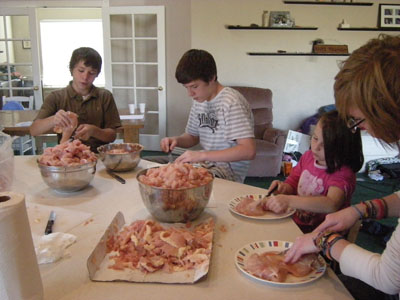
Here we are cleaning fat off the chicken and cutting up the breasts:
cutting chicken Canning (bottling) Chicken


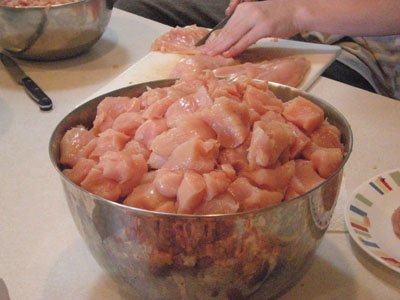
The meat needs to be cut into about 1 inch square chunks:
cut chicken Canning (bottling) Chicken


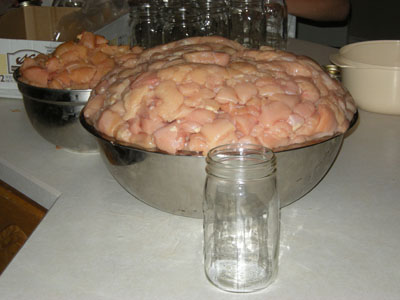
Here is what 80 pounds of chicken looks like all ready to be bottled (notice the quart jar for perspective):
all chicken cut Canning (bottling) Chicken


The next step is to put 1/2 teaspoon of salt in the bottom of the jar (you can add whatever seasoning you like) then fill the jar with chicken to about 1 inch below the top and load them into the pressure cooker:
loading cooker Canning (bottling) Chicken


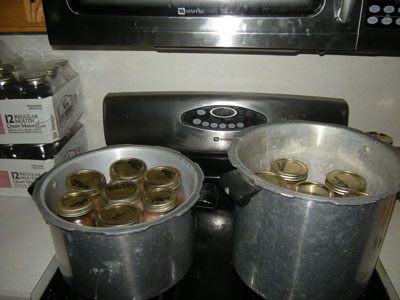
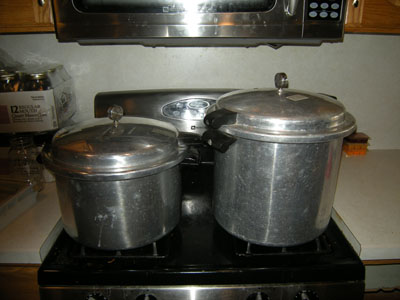
Heat up the cookers on high until they start rocking, then back off the heat until you get 3 rocks a minute, in the mountain region cook at 15 pounds of pressure. Maintain 3 rocks/minute for 90 minutes (time starts after first rock).
cookers going Canning (bottling) Chicken


After 90 minutes of cooking, turn off the heat and let the cookers sit for 30 minutes – DO NOT open them before hand, they’ll blow up! After 30 minutes, remove the rocker, if it hisses you still have pressure – WAIT until it doesn’t hiss!

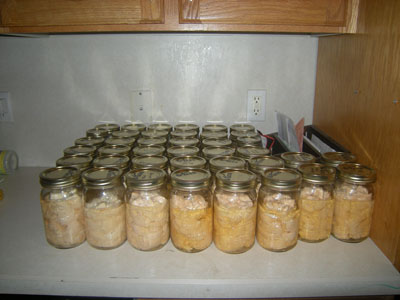
We averaged 2 pounds of chicken per bottle giving us 40 bottles:
bottled chicken Canning (bottling) Chicken


Notice in the picture that there is liquid in the jars – that’s broth baby! You don’t put any water in them at all, the cooking process fills the bottle up with juice.

After all our hard work we feasted on a bottle – it was delicious! The fully cooked chicken comes out of the bottles and falls apart and tastes wonderful.
So, let’s calculate. For about $2.50 on sale, you can buy a small tuna size can of chicken that weighs 10 ounces. We’ve got about 32 ounces in each jar, giving us a little more than 3 cans in each jar. That puts an equivalent value of $7.50 on each jar and we got 40 jars worth. That gives us $300.00 equivalent value of chicken – and it costs us $110.00 – $80 for the chicken and $30 for the jars. So we saved about $190.00 and ended up with a lot of chicken for storage! Next up for us is to do this with hamburger. I have about 80 boxes of hamburger helper in storage – my goal is to have a bottle of already cooked hamburger to go with each box.

- Phil801

SubscribeShare/Save/Bookmark